Copyhold, Leasehold and Freehold: Understanding Your Home’s History
When tracing the history of a home, understanding the legal status of the property is just as important as knowing who lived there. Terms like copyhold, leasehold and freehold frequently appear in historic deeds, conveyances and estate records. Knowing what they mean can unlock a wealth of information about your property and the lives of its past occupants.
Please note: Nothing in this article constitutes legal advice. All content is for historical and informational purposes only.
In this post, we explore copyhold, explain how it differs from other forms of tenure, and outline why it is especially relevant for researching the history of your home.
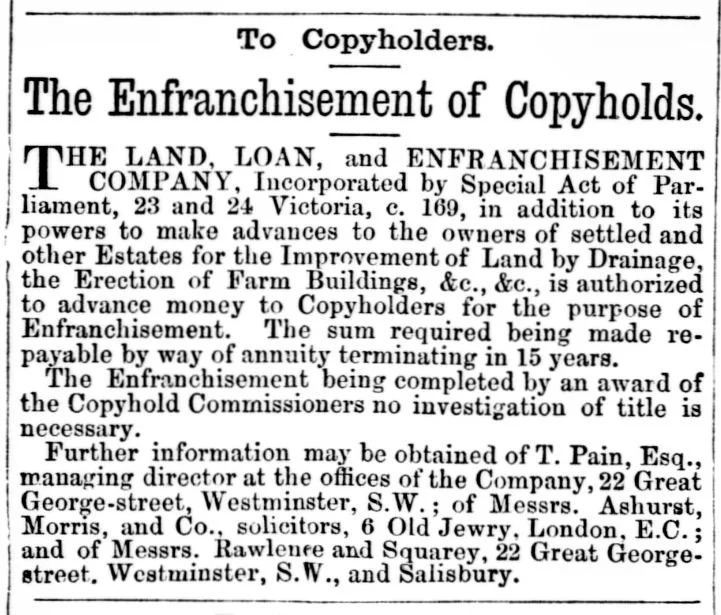
Source: Chelmsford Chronicle 27 December 1867
What Was Copyhold?
Copyhold was a form of land tenure common in England and Wales from the medieval period until it was mostly abolished in the 1920s. Properties held as copyhold were recorded in the manorial court rolls, which were the official records of a lord of the manor. Owners did not hold the land outright, but by “custom of the manor,” and their rights were documented by a copy of the court roll — hence the name copyhold.
Key characteristics of copyhold include:
Tenure by manor custom: The property was held according to rules established by the local manor
Documented by court roll copies: Instead of a modern deed, proof of ownership came from a copy of the court roll entry
Payment of fines or rents: Copyholders often owed small annual payments or fees to the lord of the manor
Limited rights to alter or sell: Any sale, inheritance or major change had to be recorded in the manor court
Because copyhold was tied to the manor system, these records often reveal a lot about the social and economic life of a community, making them invaluable to house history research.
From the 19th century onwards, many copyhold properties were converted to freehold through a process called enfranchisement. This involved the payment of a lump sum or the surrender of traditional rents to the lord of the manor in exchange for full freehold ownership.
Enfranchisement often triggered legal documentation and public announcements, many of which were published in local newspapers, estate notices or property sale advertisements. For house history researchers, these announcements are invaluable: they can confirm the date of the change, reveal the names of buyers and sellers, and provide context about the value and status of the property at the time.
Tracing enfranchisement records alongside manorial rolls, deeds, and census data can therefore give a fuller, richer picture of a home’s legal and social history.
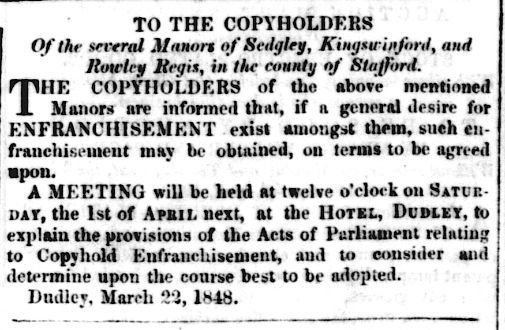
Source: Wolverhampton Chronicle 29 March 1898
Copyhold vs Leasehold vs Freehold
It can be confusing to differentiate these terms, so here’s a clear comparison:
Copyhold properties were held by custom of the manor and documented in manorial court rolls. Owners had limited rights, often owed annual fines or rents to the lord of the manor, and any transfer or inheritance had to be recorded in the court. Historically, copyhold records reveal the relationship between your home and the local manor, providing insight into rents, obligations, and restrictions that shaped the property.
Leasehold properties are held for a fixed term under a lease from a freeholder. Rights expire at the end of the lease, and occupants are typically subject to obligations to the landlord. Leasehold arrangements became common in urban developments from the 17th century onwards, and records of these leases may exist in parish or estate archives.
Freehold properties are owned outright, including the land, without an expiry date. Freehold tenure generally comes with fewer restrictions and is the standard form of ownership for modern properties. Many historic freeholds, however, can trace their origins back to manorial or estate holdings, providing valuable context for house history research.
Why Copyhold Matters in House History Research
Even though copyhold was abolished in 1926 by the Law of Property Act, understanding whether a property was once copyhold can unlock several layers of historical insight:
Access to Manor Court Records
These often contain detailed records of property boundaries, ownership transfers, rents paid, disputes and obligations. Such documents can reveal earlier owners and tenants not recorded elsewhere.Understanding Property Restrictions and Obligations
Many manorial customs imposed conditions on the land, such as what could be built, crops grown or animals kept. These restrictions often explain unusual features in historic properties.Tracing the Evolution of Tenure
A property that started as copyhold may later have converted to freehold or leasehold. Mapping these changes over time helps construct a complete ownership history.Connecting to the Local Community
Copyhold documents often mention other tenants, neighbouring properties and manor officials, providing context about the wider community and social networks around your home.
Where to Look for Copyhold Records
If your home was once copyhold, relevant records may be found in:
Manorial court rolls (often at local record offices or The National Archives)
Estate papers (family or institutional archives)
Land tax and tithe records
Historic conveyances and deeds
These sources, when combined with census records, parish registers and maps, can produce a highly detailed and human-centred history of your property.
Bringing It All Together
Understanding copyhold is crucial for anyone researching an older property, particularly homes built before 1926, or homes that were part of large estates and manorial lands. It adds a rich layer of legal and social history, helping to explain the evolution of your home and its connection to the wider community.
At House Chronicles Co, we specialise in piecing together these complex histories. By combining copyhold records with census data, maps, newspapers and parish registers, we uncover the full story of your home, from its earliest origins to the people who lived there and the customs that shaped it.
Please remember that nothing on this website, nor the information provided in this article, constitutes legal advice. All content is for informational and historical purposes only.
If you want to uncover your home’s story, explore our research packages and start your property’s Chronicle today.
